
The core update
Suno is rolling out Studio 2.0 with a set of upgrades that make the product look less like a simple AI audio editor and more like a real music production environment.
The most important addition is MIDI support. MIDI is not audio; it is a digital format that stores performance information such as notes, timing, and velocity. In modern digital audio workstations, or DAWs, MIDI is a basic building block for writing melodies, chords, bass lines, and other musical parts.
MIDI as both control and prompt

Suno says MIDI was its most requested feature, and the reason is straightforward: it gives users a more precise way to shape music than text alone. In Studio 2.0, a user can play in chords and then ask Suno to turn that MIDI into audio, extend a melody, or write a B section based on the material already performed.
That makes MIDI more than a standard production feature. In Suno’s workflow, it also becomes a musical prompt. Instead of describing an idea only with words, a user can provide actual harmonic or melodic input and let the model build from it.
There are still limits. According to the report, Suno Studio does not appear to support third-party plugins or VSTs yet, meaning users cannot currently load their preferred external instruments or effects. The built-in synth is proprietary and appears to be a basic two-oscillator wavetable synth with three envelopes and four LFOs. An LFO, or low-frequency oscillator, is commonly used to modulate parameters such as pitch, filter movement, or volume over time.
More DAW-like production tools
Studio 2.0 also adds automation, another standard DAW function. Automation lets users change parameters over the course of a song, such as gradually raising the volume of a track or moving it across the stereo field with panning.
Suno is also adding a suite of simple built-in effects, including distortion, delay, reverb, compression, and EQ. These are common mixing tools: reverb creates a sense of space, compression controls dynamics, EQ shapes frequencies, and delay or distortion can add character.
A major interface change is the arrival of a chatbot inside Studio. This is not described as a separate generator; it is tied to the current session and can use the musical context of the active project. Users can ask it for lyrics, request a new guitar line, or give instructions such as making a vocal track sound better. In response, it can add processing such as reverb, compression, and EQ.
Custom effects and AI-assisted decisions
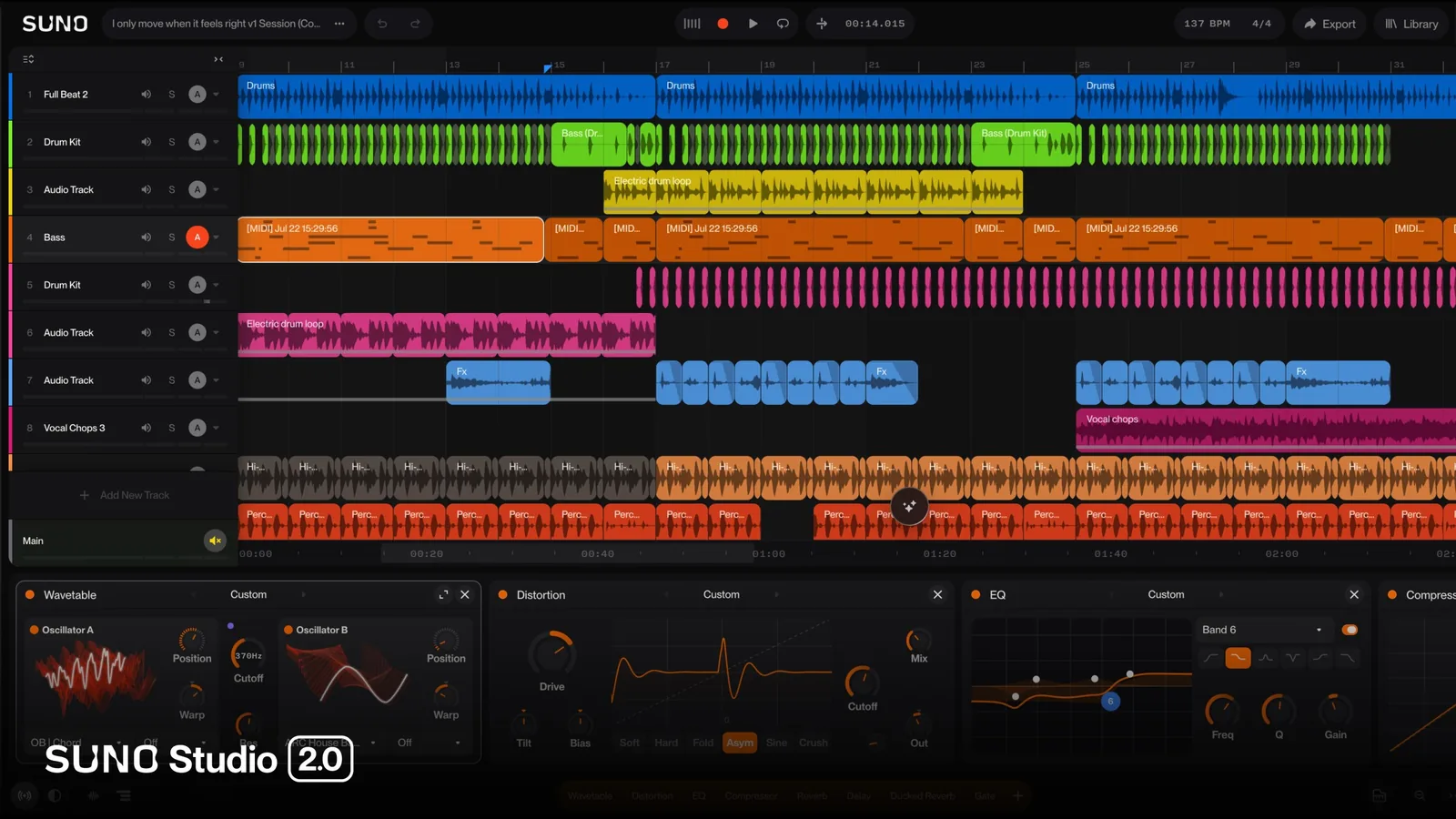
The most unusual part of the chat interface is its ability to create custom effects plugins. These may include unique reverbs, brickwalled compression, or chorus-style effects, similar in spirit to Polyend’s Endless AI guitar pedal. The effects are saved to the user’s account and can be reused later.
The update makes Studio 2.0 more feature-packed than the first version, but it also shifts more decisions toward AI. In the demo cited in the report, Suno’s Henry Phipps cleans up flubbed notes and quantizes MIDI, then says he should be asking the chatbot to do that work for him. He also lets the AI decide on a vocal chain rather than choosing the effects manually.
What it means
Suno’s direction is clear: AI music tools are moving beyond one-shot generation and into the production workflow itself. MIDI, automation, effects, and session-aware chat all point toward a more controllable creative environment.
Still, without third-party plugin or VST support, Studio 2.0 is not yet a full replacement for established DAWs. Its more realistic role is as an AI-native production space that blends composition, editing, and mixing assistance. The next competitive question for AI music software will not only be how convincing the output sounds, but how well it balances automation with creative control.