
The Two “Wings” on the Tastien Menu
Opening the delivery bag, six drumettes were jammed into the paper bucket. I took one bite and stopped — this wing was not the same thing as the Spicy Chicken Wings I ordered last week.
I called the store, and the person on the other end answered crisply: they’re the same, both are our chicken wings.
I pulled up last week’s order screenshot, placed the two types of wings side by side on the table, took a photo, and sent it over. Ten minutes later, the refund hit my account.
The difference in that side-by-side photo has a precise, gram-level term in the industry. It just never appears on any menu — it shows up on price lists at wholesale markets.
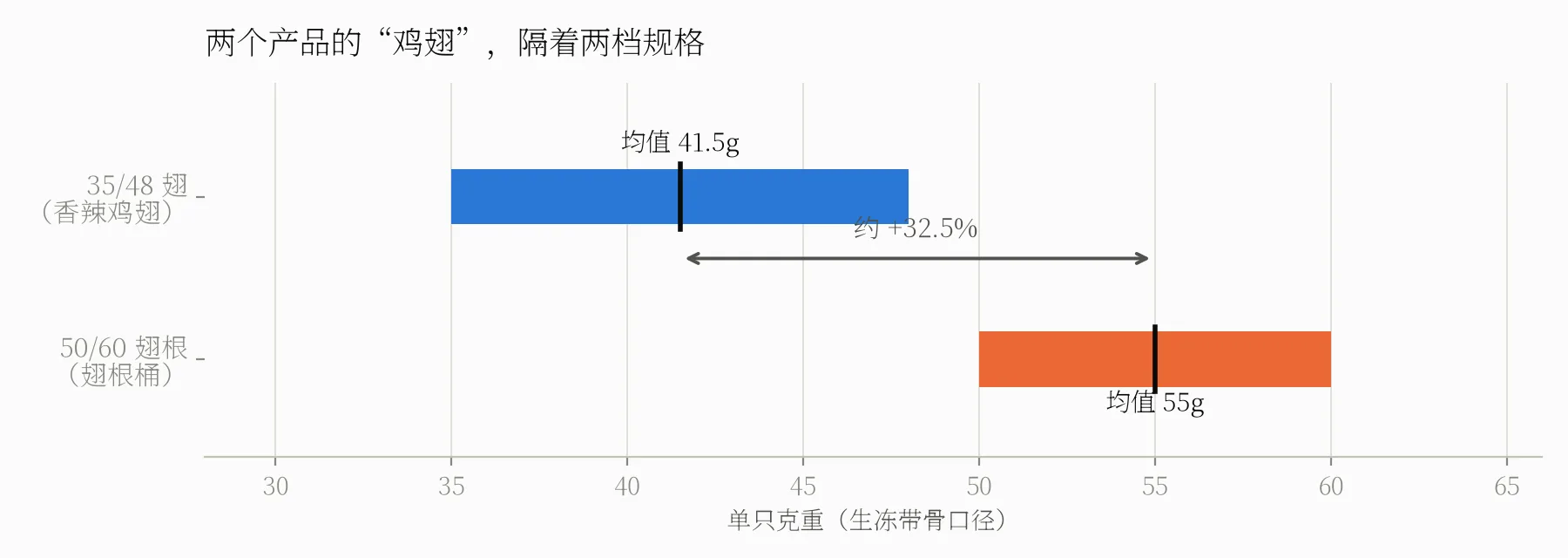
Tastien’s “Spicy Chicken Wings” use 35/48-grade wings, while the drumette bucket (officially called “Double Satisfaction Drumettes”) uses 50/60-grade drumettes. By the industry standard of per-piece weight, 35/48 averages about 41.5 grams per piece, and 50/60 averages about 55 grams per piece. Two strings of numbers separated by a menu layer that consumers can’t see, and the store tells you over the phone, “they’re the same.”
That Missing Field on the Menu
China’s chicken cut-market trades by specification grade.
Mysteel (我的钢铁网) publishes a weekly summary table of white-feather broiler cut prices by production region. Poultry meat is priced by cut and weight bracket. Here’s how drumette grades are listed:
| How It Appears on Price Lists | Meaning | Pricing Unit |
|---|---|---|
| 30-40 drumettes | 30-40 g per piece | CNY/kg |
| 40-50 drumettes | 40-50 g per piece | CNY/kg |
| 50-60 drumettes | 50-60 g per piece | CNY/kg |
How do we know these numbers mean “grams per piece” and not “pieces per kilogram”? On the same table, drumsticks are listed as “80-100 / 100-120 / 150+.” A single drumstick weighing 80–150 grams is common knowledge; if we read those numbers as “pieces per kilogram,” each drumstick would weigh only 6–12 grams — absurd. The table also lists chicken feet as “30-40克爪……70克以上爪,” where larger numbers command higher prices, confirming the direction: heavier means more expensive.
Retail evidence is even more direct. KFC’s primary chicken supplier, Liuhe (六和), prints on its retail drumette packaging: “About 34–47 pieces per pack, 35–48 g/piece (unthawed),” with a 1.66 kg pack. The three numbers — 34–47 pieces, 35–48 g/piece, and 1.66 kg — are mutually consistent. 35/48 means grams per piece.
You can also find Taihe Food’s “drumettes 35–48” on wholesale e-commerce platforms: 1.66 kg × 10 bags per case, priced at ¥345–355/case. The product description reads: “The product is located in the upper portion of the wing mid-joint, with tender meat, low ice content, suitable for BBQ, Chinese fast food, and Western fast food.” Fast food is literally written in the usage column.
Weight-Bracket Grading, Refined to an Absurd Degree
This is no粗放 industry. Grading itself is the business.
Xiu Libin (修立彬) of Heilongjiang, dubbed “Chicken King” by the media, specializes in precision chicken cutting. A NetEase report quotes him:
Wings weighing between 30 and 35 grams generally go to BBQ shops; those around 36–45 grams go to household consumers; those above 65 grams are used for smoked and braised products.
He had his workshop refine wing mid-joint grading from four tiers to twelve, and in 2018 commissioned a custom sorting machine. BBQ shops want small wings (cheaper, cook faster, look good on skewers), households want medium wings, and smoked/braised products need large wings — each weight tier maps to a channel and a price.
In other words, every commercial wing you eat has been weighed, graded, and assigned to a distribution channel before it leaves the factory. “Specification grade” isn’t some obscure jargon — it’s the infrastructure of this supply chain. Whether two fast-food chains’ wing products share the same specification is a question with a single answer, written into procurement contracts.
Two Products Both Called “Wing”
On Tastien’s official snack menu, these two products sit side by side:
- Double Satisfaction Drumettes — Spicy drumettes, great in pairs
- Spicy Chicken Wings — Crispy and juicy, spicy and satisfying
On the group-buying page, the drumette bucket is listed as “3 pairs of Double Satisfaction Drumettes, totaling 6 pieces,” with a常年 promo price of ¥13.9–20.9.
Nowhere in the product names is there any mention of weight, specification, or anatomical part. To consumers, “Spicy Drumettes” and “Spicy Chicken Wings” are simply two spicy fried wing options. To procurement, they are two different SKUs and two different specification grades. Only the merchant has the translation layer between them.
My testing confirmed: the drumette bucket uses 50/60-grade wings; the Spicy Chicken Wings use 35/48-grade wings. Over the phone, the store said, “they’re the same.”
What the Phone Call Couldn’t Explain, the Photo Could
First, we must acknowledge the consumer’s弱势 position: the sentence “I feel the chicken wings are different” is practically worthless against a customer service script.
Individual variation — yes. Batch fluctuation — yes. Batter oil absorption and frying shrinkage — all valid points. Every one of them carries a grain of truth, so every one of them can be uttered. Subjective质疑 can always be消化ed by subjective解释.
But different specification grades is a falsifiable factual claim, outside the domain of customer service scripts.
I placed both types of wings side by side in one photo: size, shape, cross-section — all visibly distinguishable. This photo did one thing: it translated “I feel they’re different” into “these two wings are different” — upgrading from subjective perception to objective evidence. Ten minutes later, ¥13.9 was refunded.
The refund itself doesn’t matter. What matters is the trigger for that turnaround: not my质疑, but that photograph. Verbal confrontation had zero effect; visual evidence landed the hit in one shot.
This Isn’t an Isolated Case — It’s Called Shrinkflation
“Reduced quantity, same price” — in economics, this is called shrinkflation. In China, it’s nothing new:
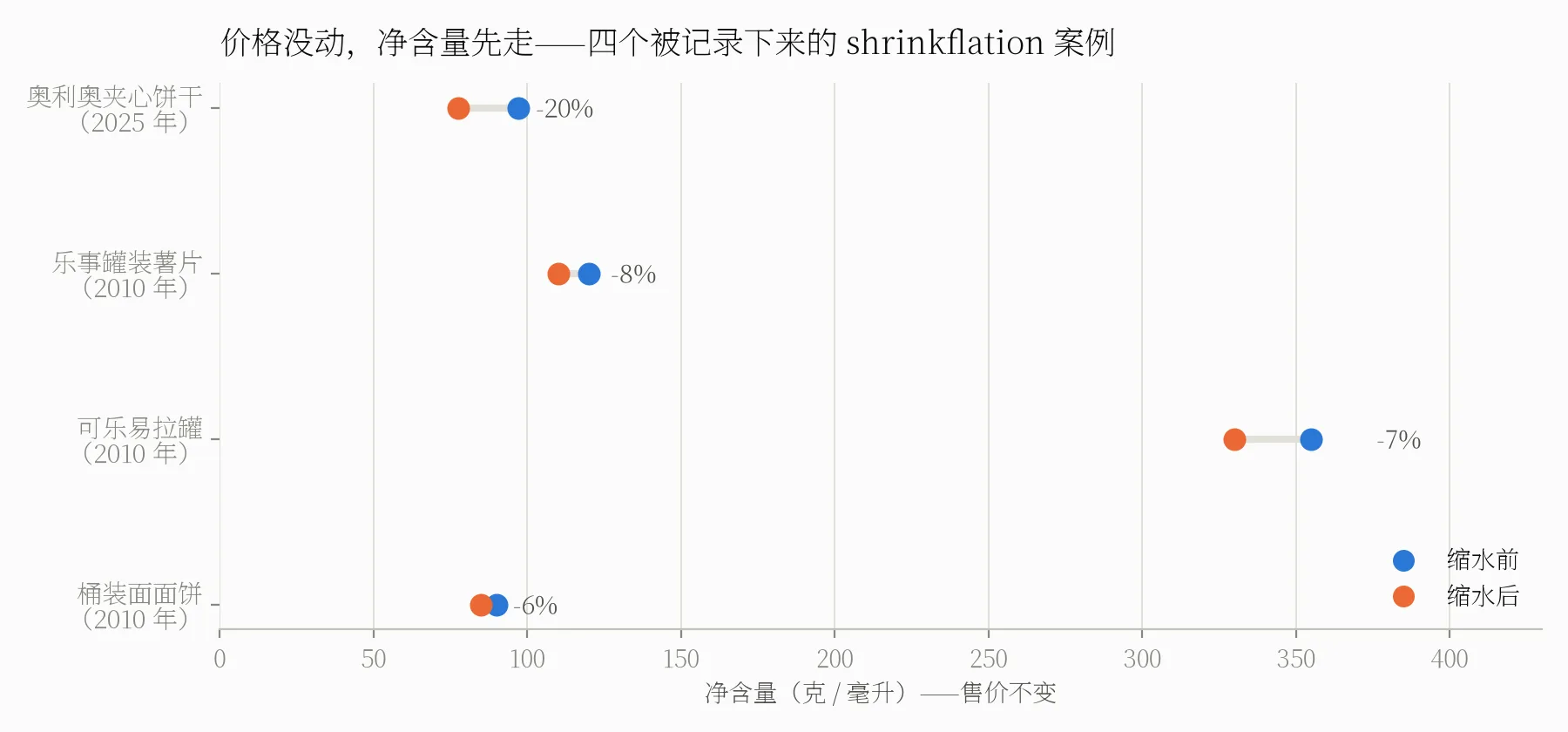
- 2010–2011: Master Kong (康师傅) and Uni-President (统一) reduced their cup noodle cakes from 90 g to 85 g at unchanged prices; Coca-Cola and Pepsi cans were reduced from 355 ml to 330 ml; Lay’s canister chips went from 120 g to 110 g. Master Kong’s response at the time was “a temporary measure to adjust product specifications” — the careful wording being that the specifications were indeed listed on the packaging, it’s just that nobody reads the gram count.
- 2023 Zhenjiang Consumer Association delivery inspection: 4 out of 18 inspected merchants had actual weights below the posted page weights, ranging from 15 g to 270 g less after removing packaging; one Huainan beef noodle soup shop advertised approximately 1000 g but tested at only 730 g.
- Discount snack retail channels: Media reports calculated that Oreo cream-filled biscuits were reduced from 97 g to 77.6 g — nearly a fifth less — while the package dimensions remained almost unchanged.
Retail shrinkflation at least still prints the net content on the packaging, so comparison is theoretically possible. Restaurant shrinkflation is more thorough: there’s no gram field on the menu at all. Switch to a lower specification grade, and there’s not even a “reduction” to point to. This is also why you can never win an argument over the phone — you’re simply not speaking on the same information plane.
If You Encounter This: A Practical Checklist
First, the legal hooks (all verified against original text):
- Article 8 of the Consumer Rights Protection Law: Consumers have the right to know the “specifications” of goods — specifications are explicitly listed in the right-to-know clause. Not listing them on the menu and refusing to answer when asked both cross the line.
- Article 20 of the Consumer Rights Protection Law: Business operators must provide truthful and comprehensive information, and must not engage in false or misleading publicity; they “shall give truthful and clear answers” to consumer inquiries. That “they’re the same” over the phone runs straight into this article.
- Article 19(4) of the Provisions on Clear Pricing and the Prohibition of Price Fraud (SAMR Order No. 56): Prohibits “using deceptive or misleading language, text, numbers, images, or videos to label prices and other price information.”
- Article 55 of the Consumer Rights Protection Law: Fraud establishment entitles you to a refund plus three times compensation, with a minimum of ¥500. But note that the prerequisite is “fraud” (subjective intent), and Article 21 of Order No. 56 gives merchants an escape hatch for “no subjective intent.” I took the refund and stopped, because the cost of proving intent — distinguishing “a clerk’s offhand remark” from “company-authorized specification substitution” — far exceeds ¥13.9.
Three-step evidence collection (per a lawyer’s guidance: Liu Xiao of Beijing Kangda Law Firm, legal advisor to SAMR):
- Take photos on the spot — the product itself, the weighing label, the packaging — all in frame.
- Keep your receipt and payment records.
- In scenarios requiring weighing, record a video that simultaneously captures the scale reading, the corresponding product, and the store signage to fix the evidentiary link.
Complaint channels: 12315 (phone / APP / 12315.cn / WeChat and Alipay mini-programs with the same name). Market supervision departments decide whether to accept a complaint within 7 working days of receipt, and close the case within 45 working days after acceptance. For delays, you can also dial 12345 to trigger dual-channel oversight.
Epilogue
That side-by-side photo is still on my phone: Spicy Chicken Wings on the left, drumettes from the bucket on the right.
Before I took the photo, the store said “they’re the same.” Afterward, ¥13.9 was refunded.
The price difference isn’t worth much. What’s valuable are those two strings of numbers that will never appear on any menu: 35/48, 50/60.