
A contest about recommendation architecture, not just leaderboard scores
Tencent Marketing used its official KDD Cup 2026 track to pose a question that has become increasingly important for large-scale advertising and recommendation systems: can recommender models move toward a unified, scalable architecture similar in spirit to the way foundation models scale?
The task focused on unified sequence modeling and feature interaction for large-scale recommender systems. Participants were asked to design a single Recommendation Block that could combine two capabilities that are often handled separately: modeling user behavior sequences and learning interactions among user, item and ad features.
Why the problem matters

Industrial recommendation systems have traditionally relied on modular pipelines. One part of the system models user histories such as views, clicks and purchases, while another part handles profile, product and advertising features. The results are then fused for ranking.
This approach has supported recommendation businesses for years, but it becomes harder to maintain as user scale, content volume and ad inventory grow. Multiple modules mean more tuning, more iteration cost and more engineering complexity. The shift toward GPU-based training and inference also makes heterogeneous architectures less efficient, because different submodules may not use hardware resources in the same way.
The competition therefore asked whether recommendation models could adopt a more homogeneous building block. In this context, a Recommendation Block means a repeatable model unit that can be stacked and expanded while handling both sequence information and feature crossing.
The scale of participation and winning ideas

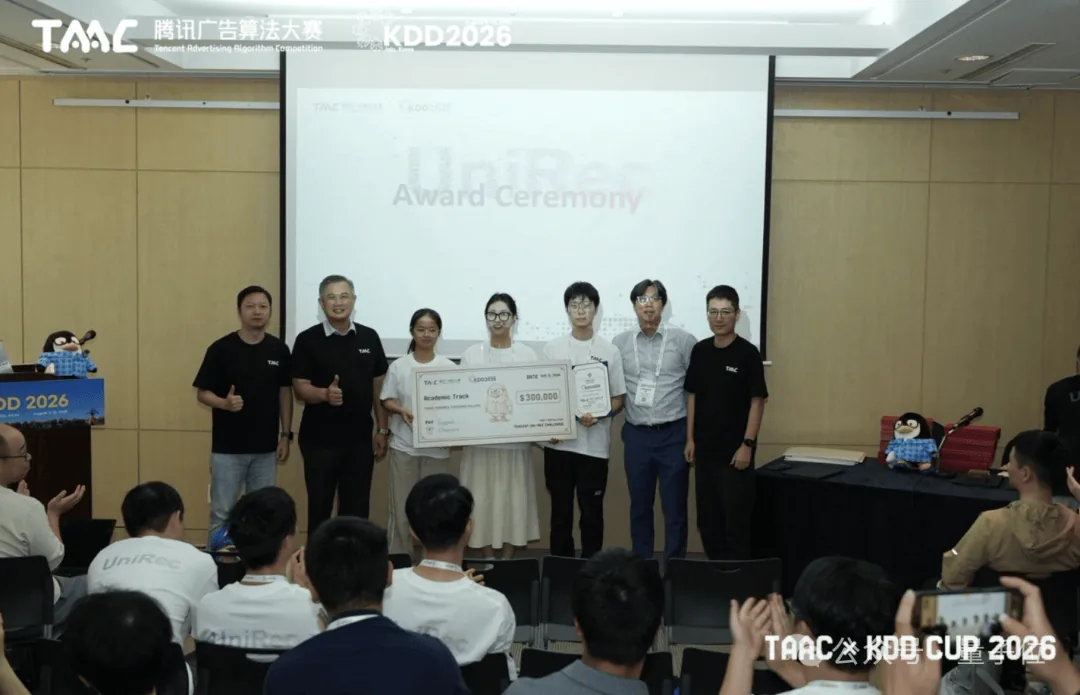
The contest attracted 13,913 participants from 52 countries and regions, forming 5,746 teams. Contestants included graduate students, industry algorithm engineers and independent developers. The total prize pool exceeded 6 million yuan, and the academic-track champion received 2 million yuan, described in the source as a record single prize among domestic enterprise technology contests.
Key figures from the competition include:
- Total prize pool: over 6 million yuan;
- Academic-track champion prize: 2 million yuan;
- Participation: 13,913 contestants and 5,746 teams;
- Industrial-track champion result: AUC improved by 0.0048 over the baseline while per-sample compute cost dropped by 18%.
The academic-track champion, lozyyeah, proposed a CRAFT feature transmission mechanism. Its design introduced an “intent token,” which can be understood as a container for user interest. Non-sequential features such as user profiles and ads generate control signals, while behavior sequences update the intent token layer by layer. The final prediction uses this refined intent representation instead of relying only on weakened raw sequence representations after many network layers.
The industrial-track champion, sunshot, proposed QueryFormer. It used candidate-item Query Tokens as global interaction hubs and embedded FM-style explicit high-order feature crosses inside the unified block. FM, or factorization machine, is a common method for learning feature combinations in recommendation tasks. The solution handled long behavior sequences and feature interaction within one framework, while measuring the AUC gain from each modification.
Efficiency is part of the benchmark
The contest deliberately avoided judging models only by offline accuracy. In recommender systems, AUC measures how well a model distinguishes between preferred and less preferred items, but a higher AUC is not enough for real deployment.
Advertising recommendation has strict latency requirements. Unlike generative AI services, which may tolerate tens or hundreds of milliseconds and can use streaming or caching, ad ranking must often respond at millisecond-level speed during page interactions. Any extra compute cost can be magnified by massive traffic.
That is why the industrial result is notable: the winning solution reported both an AUC gain and an 18% reduction in per-sample compute cost. The source also notes that the team used the DeepSeek web interface for the model code, multi-GPU distributed training logic and many ablation experiments, with only limited GPT use for final paper polishing and no paid API calls. This shows that AI coding tools are lowering the barrier to experimentation, but the competitive edge still comes from architecture design and rigorous validation.
What it signals for the industry
The TAAC and KDD Cup collaboration brought a real industrial recommendation problem to a global research and engineering audience. Beyond the main rankings, the contest also offered innovation awards for Unified Block and Scaling Law ideas, encouraging architectural insight rather than pure score chasing.
The broader message is clear: recommender systems may be moving toward their own version of a scaling era, but it will not simply copy generative AI. Advertising recommendation must balance accuracy, latency, throughput and cost. A unified architecture will matter only if it scales in both model quality and engineering efficiency. This competition does not settle the question, but it provides an early set of practical answers.