
Core Event & Key Facts
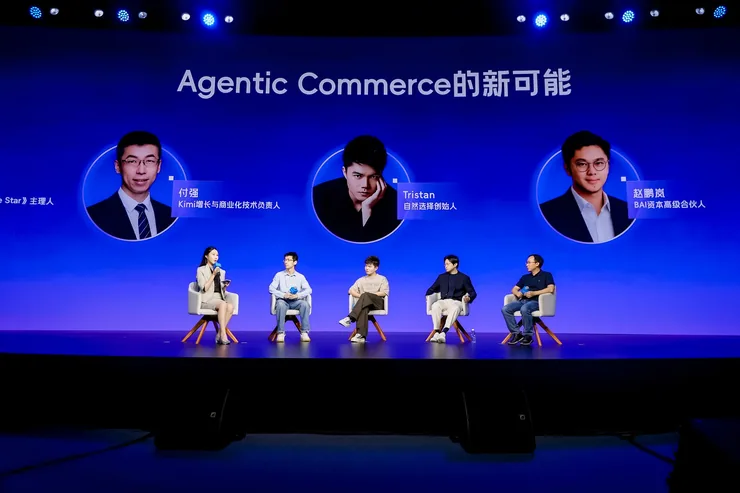
On September 11, 2026, at the “Agentic Commerce: New Possibilities” roundtable during the Inclusion·Bund Conference, industry leaders from Kimi, Ant Group, BAI Capital, and Natural Selection convened to discuss the fundamental restructuring of payment paradigms in the age of AI agents.
Key Facts:
- Date: September 11, 2026
- Event: 2026 Inclusion·Bund Conference
- Format: Roundtable discussion on Agentic Commerce
- Core Question: How does payment’s value proposition and technical architecture transform when agents become primary transaction actors?
- Participants: Fu Qiang (Kimi, Head of Growth & Commercialization Tech), Lin Zhengmao (Ant Group, AI Payment Director), Zhao Penglan (BAI Capital, Senior Partner), Tristan (Founder, Natural Selection)
The Shift: Payment evolved from “the final step of human transactions” to “the critical gateway for AI entering real commerce”—transitioning from endpoint to full-chain orchestrator.
Intention-Driven Transactions: A Paradigm Shift in Commerce Initiation
Lin Zhengmao emphasized that AI-era payment logic has fundamentally changed: users only need to express intent and grant authorization; agents independently handle product search, ordering, and payment. Fu Qiang illustrated this with Kimi’s subscription model—LOCAL model voice interaction enables uninterrupted service continuity. Voice has become the primary mode of human-AI interaction.
More significantly, the transaction subject expanded from solitary humans to a hybrid human-agent ecosystem. Tristan shared a real case where a user’s complaint about high Shanghai-Tokyo flight prices triggered an automated ticket-selling agent to proactively identify demand and initiate a recommendation—without the user ever uttering “I want to buy.” This AI-driven撮合 (matching) has surpassed traditional search-and-recommendation paradigms.
##硅基生命 Payment: Birth of a New Growth Dimension
Zhao Penglan introduced the concept of “silicon-based life payment,” revealing AI’s true增量 (incremental value):
- A research agent can invoke APIs 500 times per minute, each transaction costing mere cents or less
- Human comparison: “Try processing 500 payments per minute on your credit card; your account will be frozen the next day”
Such high-frequency, low-amount, millisecond-level micro-payments were physically impossible in human-dominated commerce. AI doesn’t merely relocate existing consumption to AI interfaces—it creates transaction types that never existed.
New Gateways & Trust Infrastructure: Dual Reconfiguration of Network Effects
Payment’s network effect is being redefine in the agent era:
- Traditional Internet: Network Effect ≈ Node Count²
- AI Era: Network Effect ≈ Node Count² × Context Depth
Tristan asserted智能体 (agents) achieve “epic-level strengthened” network effects via large-model, high-dimensional connections. Simultaneously, traffic gateways have migrated: Platforms once controlled流量 (traffic); future gateways are users’ personal agents.
This demands a business logic shift. Businesses must now secure AGENT trust to trigger recommendations—林正mao noted payment systems have become the core infrastructure for agent authorization权限 (permissions).
Reader Strategies
- For Developers: Build agent-facing platforms (e.g., API monetization, research toolkits) with integrated micro-payment and agent identity authentication—avoid merely retrofitting existing payment APIs
- For Enterprise Leaders: Audit business processes for intent abstraction capability and design agent-interaction layers with trust evaluation models
In Closing
Payment’s value redefinition mirrors the transfer of commercial sovereignty from human hands to AI cognition. While models equip agents with capability, payment and trust systems determine how far they can go—this is less a technical integration challenge and more the foundational protocol design for a new commercial civilization.