
Core Incident
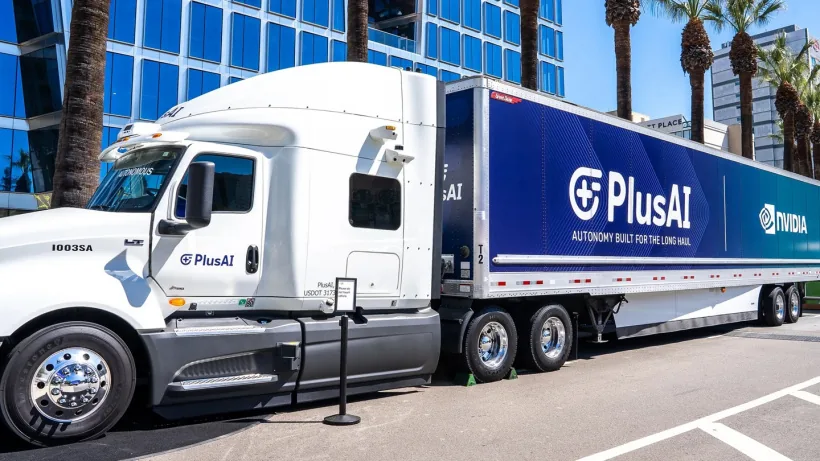
On September 27, 2026, IT之家 reported—citing The Wire—that PlusAI, a U.S.-based autonomous trucking developer, discovered two of its heavy-duty test trucks missing from outside their warehouse. Local police soon intervened and reclaimed both vehicles. Key facts:
- Incident timing: Late September 2026 (exact date undisclosed)
- Affected vehicles: Two trucks bearing PlusAI and NVIDIA logos
- Cargo onboard: 40,000 pounds (≈18.1 metric tons) of sand, used as simulated payload
- Vehicle condition: Cab interiors undamaged; sand remained fully intact
- Status: Investigation ongoing; no arrests made to date
Timeline of Events
The anomaly began with an innocuous text message: A PlusAI executive received a congratulatory note from an acquaintance stating, “I’ve always been proud of your success—I just saw your two trucks parked near my company premises! :)”, sent on a Thursday.
The executive immediately flagged the discrepancy. PlusAI trucks should have been stationed outside the company warehouse—not at the acquaintance’s Newark, California office. Local law enforcement responded promptly, aiding PlusAI in locating and recovering both vehicles.
The critical misjudgment: The trucks’ prominent side decals—featuring both PlusAI and NVIDIA logos—lured thieves into believing the vehicles carried high-value tech hardware. As reported, “thieves certainly dragged the trailer away because of this logo.” In reality, no electronics or valuable cargo existed onboard—only sand for simulation purposes.
PlusAI confirmed the recovered trucks sustained no intrusion, and the 40,000-pound sand payload remained securely in place. The perpetrators, unable to extract or resell inert sand, likely abandoned the trailers quickly after transport.
Industry Context: Simulated Payloads in Testing
Autonomous truck developers routinely use simulated payloads during route validation. Loading real freight introduces unnecessary risk during iterative software testing, prompting firms to substitute fixed-weight ballast—such as sandbags, concrete blocks, or steel weights—to mimic fully loaded conditions. A 40,000-pound load (≈18.1 metric tons) represents a typical medium- or heavy-duty Class 8 tractor-trailer满载 scenario, enabling engineers to verify brake performance, suspension dynamics, and autonomous decision latency under physical stress.
Crucially, NVIDIA’s presence on vehicle exteriors reflects its role as a chip supplier, not cargo indicator. NVIDIA does not manufacture vehicles or ship trucks; its logo signals collaboration with OEMs or autonomy stack providers. The incident underscores a public misconception: Tech branding often signals sophistication, yet here, the very visibility of that branding attracted low-reward criminal attention.
Practical Guidance for Stakeholders
- Fleet operators: Evaluate perimeter security for parked test units. If vehicles display联合-branding for marketing or partner visibility, add spatial logging (e.g., timestamped location snapshots) to detect unauthorized movement.
- Public awareness: Encountering vehicles adorned with prominent tech logos does not imply high-value contents. Autonomous testing trucks are prototypes—not commercial transports—and onboard equipment is either non-removable or similarly low-value.
- Remediation: Consider discreet tagging or low-visibility tracking modules (e.g., Bluetooth LE beacons) on test fleets, without compromising the vehicle’s aesthetic or the partner relationship. PlusAI did not disclose whether GPS monitoring was active; this incident may激励the industry to standardize lightweight geo-fencing.
Final Thoughts
As autonomous freight adoption progresses, real-world testing remains a visibility-intensive phase. Thousands of miles of autonomous driving tests are conducted annually across the U.S., often in public spaces. This “sand heist” was both absurd and revealing: The gap between brand perception (NVIDIA = expensive silicon) and physical reality (沙 = low-value aggregate) created the perfect conditions for a non-transferrable theft. Moving forward, security frameworks must evolve beyond decorative branding toward layered safeguards—where technological prestige no longer serves as a misleading beacon for minor crimes.平衡 transparency with operational discretion becomes essential for responsible innovation.