
Agentic RAG Architecture Evolution: Three Generations of Self-Correction
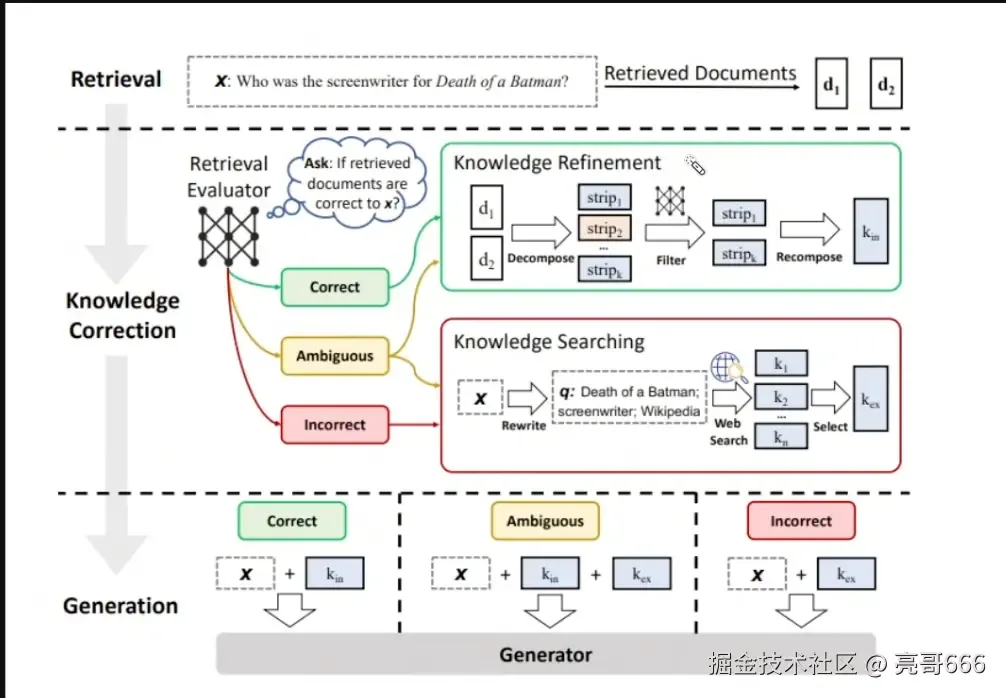
Retrieval-Augmented Generation (RAG) faces three universal pain points in deployment: blind retrieval wastes compute, trusting low-quality docs causes hallucination, and generation lacks post-hoc verification. Industry has evolved three generations of Agentic RAG architectures to address these: basic retrieval self-correction, standard CRAG, and Self-RAG with feedback loops. These represent fundamental shifts from linear pipelines to bidirectional reflexive闭环.
The core distinctions:
- Option 1: Local Recirculation — Triggers re-search after quality screening but risks infinite loops when local docs are absent
- Option 2: Dual-Threshold Fallback — Uses CORRECT/INCORRECT/AMBIGUOUS verdicts with web search as fallback when local knowledge is insufficient
- Option 3: Pre-Gate + Post-Production Dual Audit — Saves compute upfront, material audit removes noise, and answer verification downstream blocks hallucination with complete feedback loops
Basic Retrieval Self-Correction: A Double-Edged Simple Loop
The basic retrieval self-correction design follows a朴素 logic: “Evaluate after retrieval; if不合格, rephrase query and re-search locally.” Its five-step flow: user query → agent decides retrieval need → local vector search → quality evaluation → good results → generate; bad results → re-query → loop back to retrieval.
This works well when local knowledge is comprehensive, but has two engineering fatal flaws: systems enter infinite loops and crash on timeout when local docs lack relevant content; and absence of external data fallback limits self-healing. Its core flaw is operating solely within local knowledge bounds, unable to cross data source boundaries.
Standard CRAG: Industrial-Grade Single-Direction Pipeline
CRAG (Corrective RAG) solves knowledge gaps and document noise via external fallback and sentence-level denoising. Its innovation lies in dual-threshold triage: UPPER_TH=0.7, LOWER_TH=0.3, categorizing docs into three verdicts:
- Any chunk score > 0.7 → CORRECT → use local good docs directly
- All chunks score < 0.3 → INCORRECT → trigger web search fallback
- 0.3 ≤ all scores ≤ 0.7 → AMBIGUOUS → mix local weak and web strong docs
The counterintuitive insight: CRAG abandons retry loops entirely. Its acyclic topology guarantees predictable latency/cost, a critical production advantage.
Sentence-level denoising is its other core feature. Whether local or web docs, all material gets split into sentences and filtered by a dedicated small model. Irrelevant content discarded; final context is extremely clean, blocking hallucination origins. Production must parallelize sentence filtering with ultra-fast small models such as GPT-4o-mini, else serial processing bottlenecks performance.
Self-RAG: Bidirectional Quality Control with Dual Sentinels
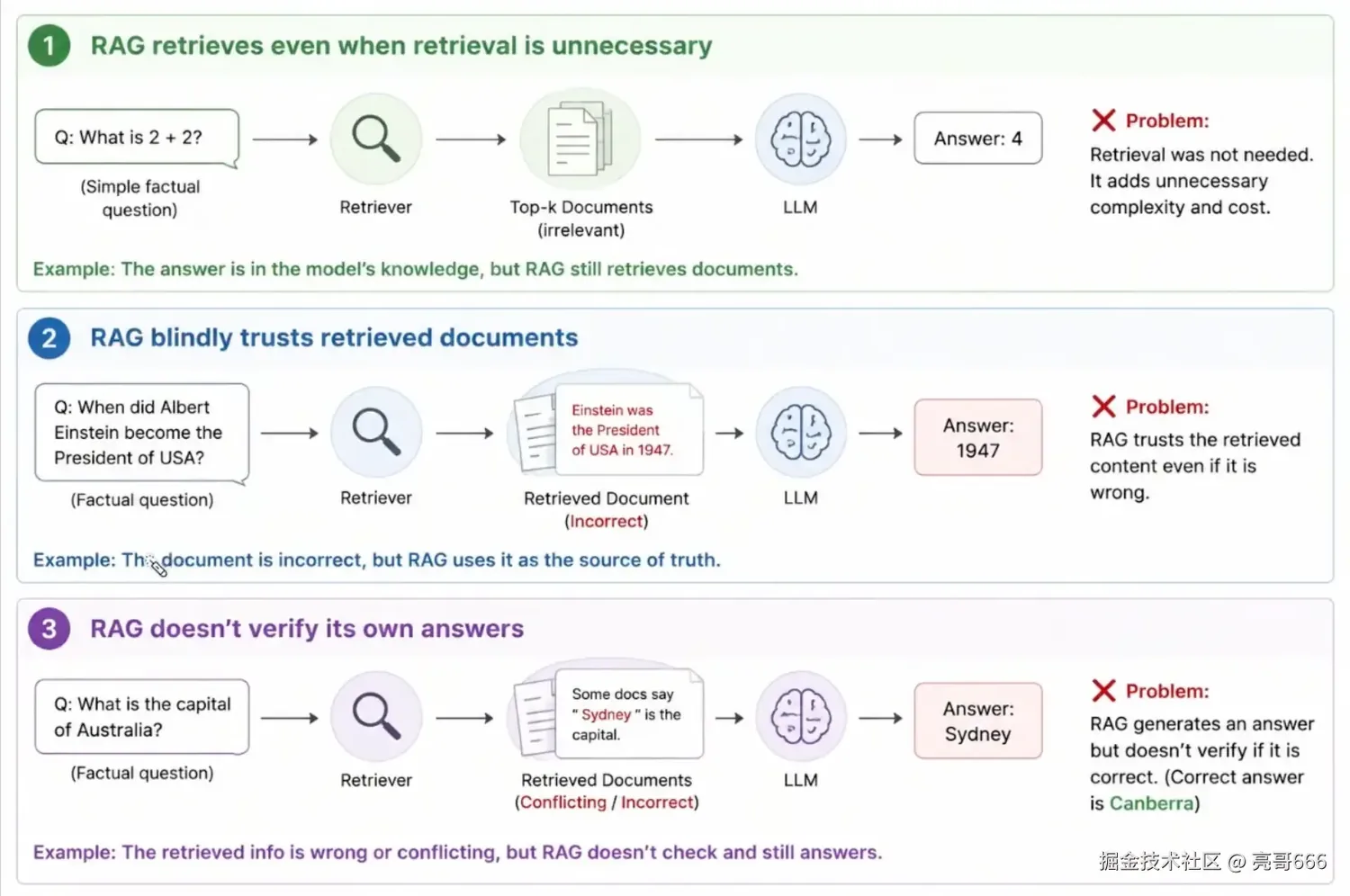
Self-RAG addresses three classic RAG hard failures: blind retrieval, blind trust, unvalidated outputs. Its “3+1 security layers”:
- Layer 1 (Pre-Query Review): decide_retrieval node saves compute. Skip retrieval for 2+2=? common knowledge questions
- Layer 1.5 (Material Audit): is_relevant node scrutinizes each doc, filtering out “Einstein elected US president” hoaxes
- Layer 2+3 (Post-Production Dual Audit): Merged into single audit_llm call checking is_grounded AND is_useful simultaneously
- Layer 3 (Relevance Check): Ensures answers stay on-topic
The engineering killer feature is dual-audit consolidation. Pydantic structured output one call completes both checks, saving 1-2s latency vs论文’s dual calls, cutting 50% input tokens.
Two feedback loop types emerge:
- Micro loop: When is_useful passes but is_grounded fails → revise_answer local edit, no re-retrieval needed
- Macro loop: When is_useful fails → rewrite_question → re-retrieve
Adoption Guidance
Quick deployment: Known, complete local knowledge → basic self-correction (lowest implementation cost)
Balanced production fit: General-purpose with quality/cost tradeoff → standard CRAG (acyclic topology ensures predictable latency, dual-threshold suits most business)
High-value Q&A: Finance/legal/medical sectors where answer accuracy is critical → Self-RAG’s bidirectional audit, though complex, blocks hallucination most effectively. When error costs are high, extra engineering complexity is justified.
Final Thoughts
Three generations reveal a clear trend: RAG reliability increasingly depends on internal metacognitive capabilities. From simple loops to complex feedback cycles, the essence is continuous tradeoff between reducing LLM naivety and enhancing system self-inspection. Future evolution likely trends toward graph-based orchestration—treating audit, rewrite, retrieve, generate as composable Agent nodes rather than rigid pipelines.