
Core Announcement: NeoHorse Model Launch
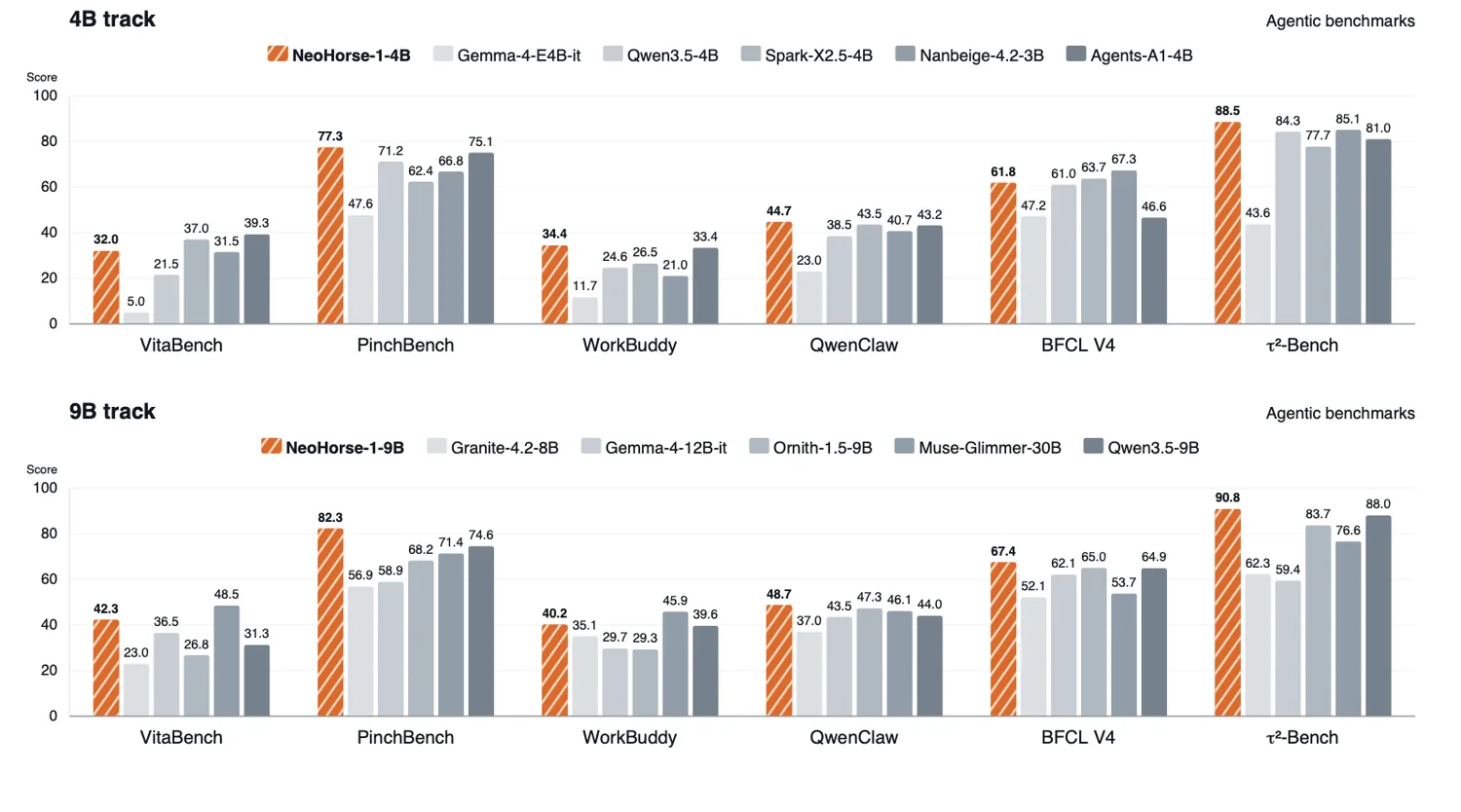
TokenRhythm, in collaboration with Wquina Tech, Tsinghua University, Peking University, and Alibaba, has launched the first Agent-Native model NeoHorse-1, available in two parameter scales: 4B and 9B. Unlike conventional instruction-tuned models, NeoHorse learns directly from execution trajectories generated by Agent tool usage, feedback reception, and error correction processes.
Key factual details:
- Release time: September 2026 (technical report published)
- Model versions: NeoHorse-1 with 4B and 9B parameter configurations
- Base model: Fine-tuned from Alibaba’s open-source Qwen3.5-4B and Qwen3.5-9B
- Training paradigm: Execution trajectory supervision + On-Policy Distillation, where a teacher model provides guidance based on student’s actual generated output
- Open-source status: The Routing Harness system OpenSquilla is open-source; model weights are not yet explicitly confirmed as open
Note: Agent-Native means the model’s training objective fully aligns with Agent execution flow—i.e., model predictions constitute the decision chain in real Agent workflows, not predictions made externally for later orchestration.
Training Method: Execution Trajectories as Primary Data Source
NeoHorse’s training corpus centers on execution trajectories produced by OpenSquilla, TokenRhythm’s open-source Routing Harness system. OpenSquilla selects and orchestrates different models during Agent task execution. Its trajectories include complete pipeline data:
- Capability demand estimation
- Routing decisions
- Model responses
- Tool invocations
- Environmental feedback
Traces undergo integrity checks and three quality assessments:
- Task completion — was the objective achieved?
- Evidence consistency — is the intermediate reasoning consistent with final outcome?
- Error recovery — can the system adjust and retry after failure?
The team further employs routing-signal-driven dynamic scheduling: Adjusts training order based on estimated required capabilities, and applies on-policy distillation where the teacher corrects weaknesses in the student’s actual outputs.
Benchmark Results: 4B Surpasses 9B Base Model in Key Areas
NeoHorse was evaluated on 11 benchmarks covering Agent execution, tool interaction, code generation, and instruction following.
Key findings:
- Weighted average score: NeoHorse 4B ranked highest among all 4B-level models
- 5 benchmarks outperformed Qwen3.5-9B base model
- Greatest improvements evident in tasks with clear workflows, observable feedback, and verifiable outputs
- 9B version retains advantage in complex state maintenance, long-horizon debugging, and failure recovery, underscoring continued need for larger capacity in error-prone scenarios
Surprise & Contrast: Small Models Excel on Structured Tasks
A notable anomaly highlights a key insight:
A 4B base model once missed a crucial email containing updated dependency constraints, resulting in files being written to incorrect locations. After NeoHorse fine-tuning, its performance on similar structured tasks surged—even surpassing the original 9B base model on those benchmarks.
This demonstrates: Execution-trajectory training enables smaller models to achieve capability leaps on targeted, well-defined tasks, defeating larger yet mismatched baselines—offering promising deployment alternatives for resource-constrained environments.
Industrial Collaboration: A Coordinated Open-Source Ecosystem
This project exemplifies full-stack collaboration across China’s open-source AI stack:
| Role | Contribution |
|---|---|
| TokenRhythm | Agent-Native architecture design, OpenSquilla development, training methodology |
| Wquina Tech | Infra support via model-chip co-optimization, improved training efficiency and cost reduction |
| Tsinghua & Peking Universities | Algorithm and training innovation, scaling curve optimization research |
| Alibaba | Open-source Qwen3.5 base model |
The \“base model—algorithm—infrastructure—feedback\” four-layer synergy confirms a viable path for rapid iteration of indigenous Chinese models.
Practical Recommendations for Readers
Adopt now if:
- Deploying Agents in structured, feedback-rich environments (e.g. automated scheduling, document validation, standardized code generation); NeoHorse 4B offers a lightweight, high-performance option
- Researching trajectory collection pipelines; OpenSquilla enables Straightforward reproduction and task-to-pipeline mapping
Wait if:
- Your use case involves long, stateful chains with ambiguous goals (e.g. complex development orchestration, cross-system integration debugging); 9B remains more robust
- You require open weights (no official open-weight commitment yet from TokenRhythm)
Final Note
NeoHorse’s single-round RSI (Recursive Self-Improvement) validation is not a final product—it is the first tangible demonstration that an open-ecosystem loop \“Agent execution—evaluation highlights gaps—training adaptation—model update\” can be executed end-to-end. Where training data originates from real-world task execution, models与 environments co-evolve with stronger real-world grounding.