
Core Event & Key Timeline
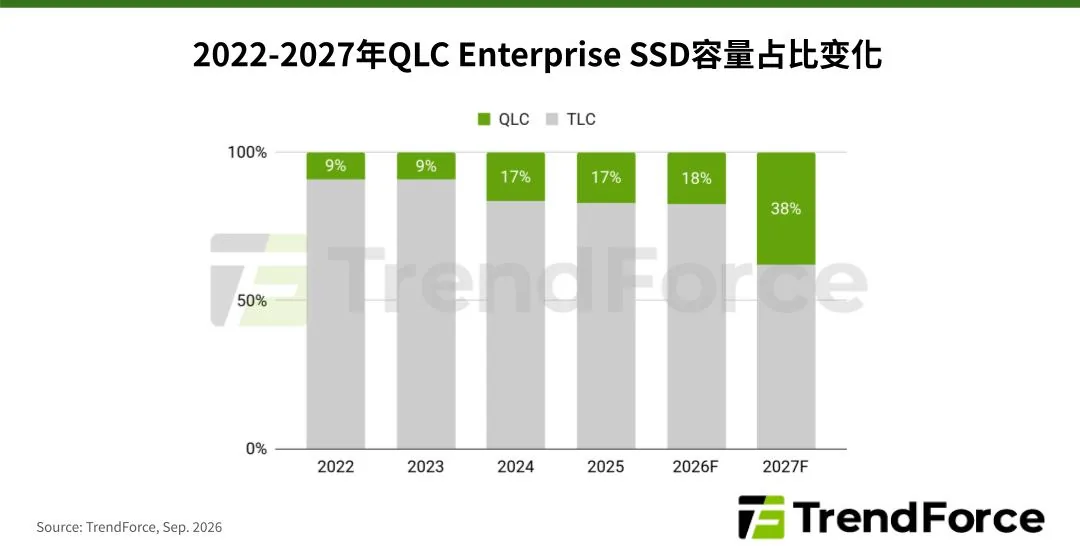
TrendForce and LighForce Research published a forecast on September 21, 2026, predicting sustained price gains for enterprise SSD (eSSD) in Q4 2026, with order volumes expected to surpass the Q3 peak driven by continued strong procurement from North American cloud service providers (CSPs).
- Release date: September 21, 2026 (Thursday)
- Forecast period: Q4 2026
- Market direction: eSSD prices to maintain uptrend; Q4 orders to rise sequentially
- Technology focus: QLC (Quad-Level Cell) products driving growth momentum
- Driver shift: Demand shifting from AI training to AI inference and落地 applications
Demand Evolution: From AI Training to Inference Deployment
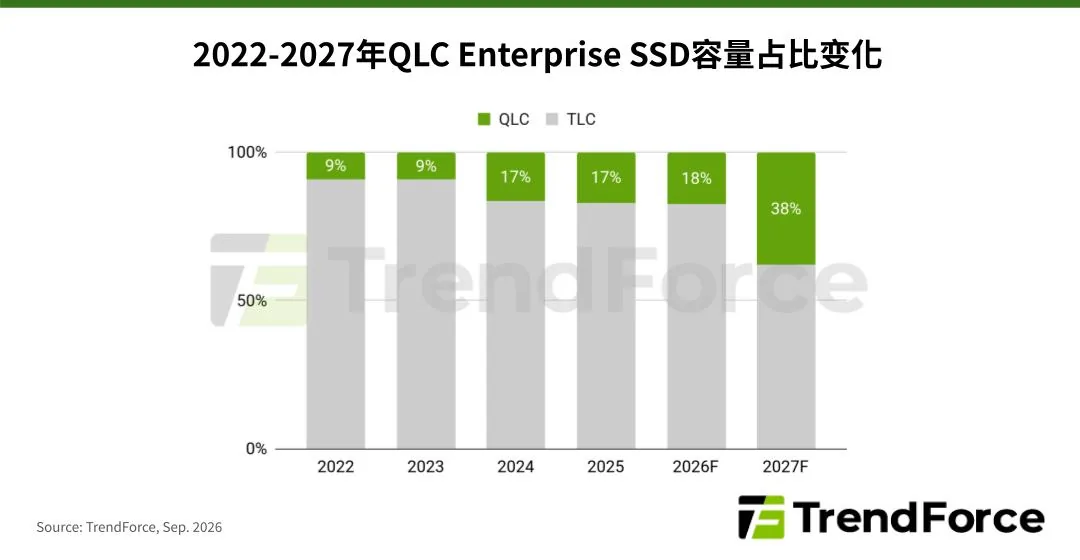
TrendForce notes a fundamental shift in the logic behind this eSSD procurement surge. Initial demand driven by large language model (LLM) training is rapidly evolving toward concrete AI落地 applications. The critical inflection point: as Agentic AI system construction accelerates, demand for massive real-time data extraction and caching has multiplied—placing higher demands on storage capacity and cost efficiency.
QLC technology therefore emerges as the optimal cost-performance solution. QLC (Quad-Level Cell) stores 4 bits per memory cell, offering lower per-unit-capacity cost than TLC (Triple-Level Cell), though with relatively shorter endurance and lower write performance. However, for read-heavy inference and caching workloads, QLC is fully adequate.
Two specific application paths have emerged: first, 承载 non-structured data in vector databases; second, KV Cache Offload mechanisms. The latter, pioneered by Chinese AI vendors like DeepSeek, achieves model inference efficiency gains at lower hardware cost by offloading GPU cache key-value pairs to high-speed, high-capacity QLC SSDs.
Market Shift: QLC Adoption Expands
TrendForce emphasizes this Q4 demand surge extends beyond high-performance TLC products—QLC products, with lower unit-capacity cost and higher cost-effectiveness, are the primary growth engine. Major North American cloud vendors are accelerating eSSD deployment scale and application scenarios, driving Q4 order totals above Q3 peaks.
Fabs also benefit significantly, with enhanced production capacity allocation control and pricing power in the enterprise market—reinforcing the solid foundation for sustained price uptrends.
| Product Type | Bits per Cell | Cost Efficiency | Target Applications | Endurance |
|---|---|---|---|---|
| QLC | 4 bits/cell | High (low per GB cost) | Read-heavy: inference, KV Cache Offload, vector DB | Shorter |
| TLC | 3 bits/cell | Medium | High-write performance: training | Longer |
| SLC | 1 bit/cell | Low | Critical write workloads | Longest |
Note: Data derived from original text comparing QLC and TLC; SLC is industry-standard reference, not explicitly mentioned.
Implementation Recommendations
QLC eSSD suitable for: Cloud vendors building or optimizing Agentic AI systems; vector database implementations for non-structured data (RAG); KV Cache Offload platforms seeking inference efficiency with cost reduction.
Consider waiting if: Your workload involves high-frequency writes or strict low-latency requirements; you have tight budgets and QLC supply chain constraints; or your use case demands extreme data durability (e.g., financial core transaction ledgers).
In closing
The structural shift in the eSSD market signals AI compute advancement is moving beyond raw chip performance toward hardware-software co-optimization. QLC technology, by enabling cost-efficient scaling, is transforming AI accessibility—marking not just a storage technology choice, but an evolution in AI engineering methodology.