
Data, not demos, is becoming the agent bottleneck
A sponsored report produced by MIT Technology Review Insights in partnership with Google Cloud argues that enterprise adoption of agentic AI is accelerating, but the return on investment depends heavily on whether organizations have a trustworthy data foundation.
Agentic AI refers to AI systems that do more than answer questions: they can plan, call tools, access business systems, and take actions toward a goal. That shift creates new demands on enterprise infrastructure. Agents need structured data such as records and tables, unstructured data such as documents, and business context that tells them what the data means and how it should be used. They also need access to operational systems, including supply chain, point-of-sale, and human resources platforms.
What the survey found
The report is based on a survey of 300 data and technology executives. Its central finding is that many companies are asking AI agents to transform work while giving them access to only a limited portion of enterprise data.
Key figures include:
- Across surveyed organizations, AI can access an average of 45% of company data.
- Among organizations described as “data laggards,” access drops to 30% or less.
- A smaller group of “data leaders” gives AI access to more than 70% of company data.
- Only about half of surveyed organizations trust that their agents’ decisions are accurate and relevant.
- Among data leaders, 100% report trust in agent decisions.
- Among data laggards, 66% say legacy systems limit agent scaling, while 68% say they prevent agents from making decisions at speed.
- Among data leaders, only 8% report either of those constraints.
The numbers point to a practical problem: agent performance is not only a model issue. If data is fragmented, poorly governed, or disconnected from business systems, agents may struggle to make reliable decisions even when the underlying AI model is capable.
Trust depends on governance and context
The report frames trust in AI decisions as a reflection of data readiness. In this context, data governance means managing data quality, permissions, definitions, lineage, and rules of use so that systems can rely on information safely and consistently.
For agents, context matters as much as access. A term like inventory, customer, or employee can mean different things in different departments or systems. Without shared definitions and clear authorization rules, an agent may not know which data is current, which source is authoritative, or which action is permitted.
That is why the report highlights two priorities for scaling: improving agent access to both structured and unstructured data, and strengthening data and AI governance with business context. Data leaders are also focusing on automating data management, because manual processes can become a bottleneck as agents spread across more workflows.
The next phase of enterprise AI
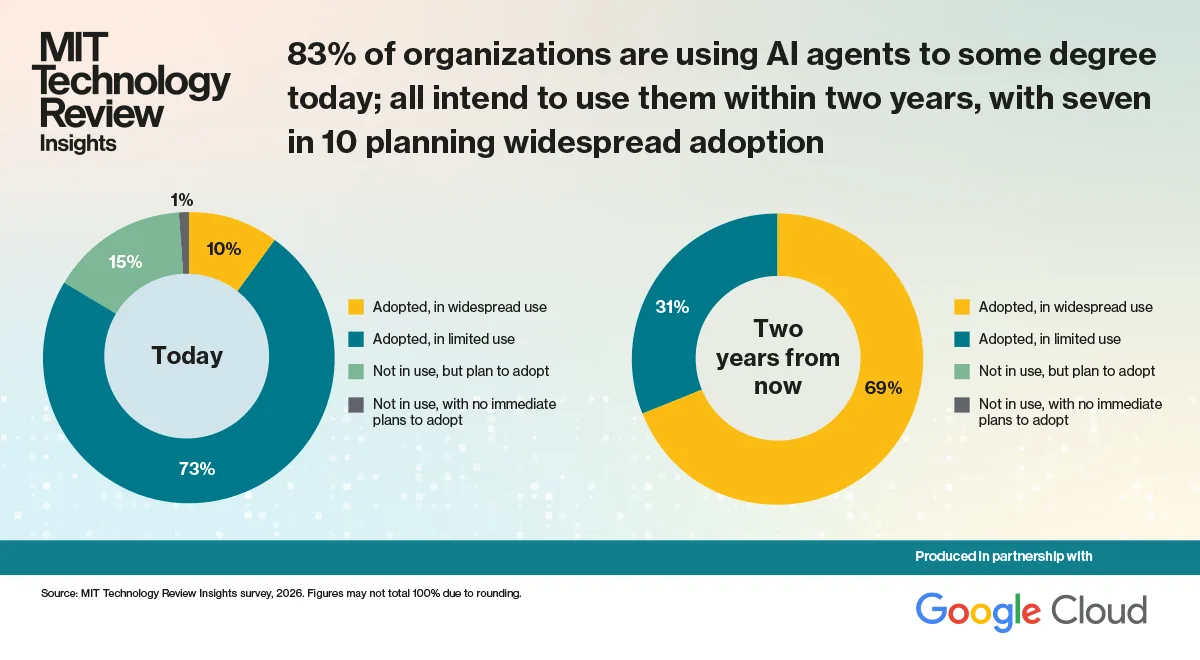
The report says all respondents expect to be using agentic AI within two years, and 69% expect broad use. If that happens, enterprise data architectures will need to support not just analytics and reporting, but real-time operational action.
The article also cites Gartner’s prediction that AI agents will augment or automate 50% of business decisions by 2027. Whether that level of adoption materializes or not, the direction is clear: companies will need to modernize legacy data systems if they want agents to work at speed and scale.
Because the article is sponsored content created by MIT Technology Review Insights with Google Cloud, it should be read as an industry research report rather than an independent product review. Still, its broader message is consistent with what many enterprises are facing: the race is shifting from experimenting with AI models to preparing trustworthy data environments. Organizations that can connect data access, governance, and business processes are more likely to turn agents from pilots into production tools.