
A default policy triggers a creator backlash
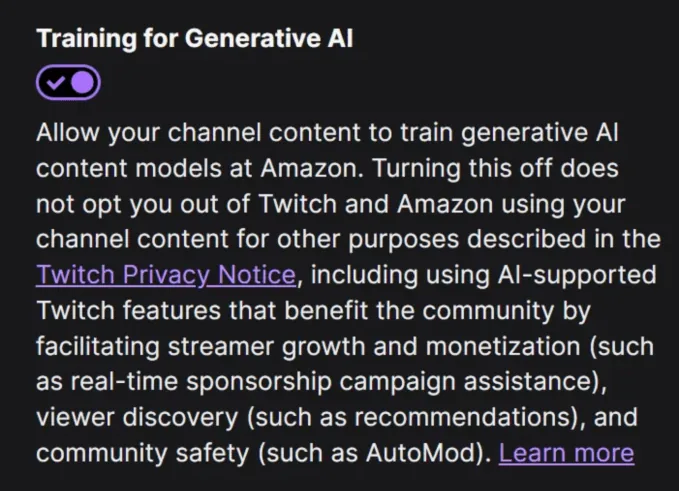
Twitch will allow Amazon, its parent company, to use creators’ channel content to train generative AI models by default, unless streamers manually opt out. The decision has quickly drawn criticism from the Twitch community, largely because the policy begins from presumed consent rather than asking creators to opt in first.
For Amazon, Twitch represents a large pool of audio and video material: long livestreams, recorded broadcasts, creator voices, and on-camera performances. For streamers, that same material is often central to their identity and business. Generative AI refers to models that can produce new text, images, audio, or video based on patterns learned from training data, which makes rich livestream recordings especially valuable.
The main concern is not merely that Twitch offers an opt-out, but that creators are included by default. Many users fear their work could be used for AI training without them realizing a setting has changed.
Twitch says the quiet part out loud
During a livestream on Twitch’s official channel, Head of Community Mary Kish and Chief Product Officer Mike Minton addressed nearly 3,000 viewers, many of whom were posting anti-AI messages in chat. Users repeatedly asked why the policy was not opt-in.
Minton’s answer was unusually blunt: if the feature were opt-in, “nobody would opt in.” He described that as the honest answer. The statement helped explain the business logic behind the default, but it also sharpened the community’s concern: if Twitch expects most creators would refuse when asked directly, default participation may feel less like consent and more like reliance on inattention.
Twitch appears aware that its creator base is broadly skeptical of generative AI. Much of the public criticism around AI systems has focused on books, images, videos, and other online materials used for training without clear permission. On a platform built around personal voice, performance style, and audience relationships, that concern becomes even more sensitive.
Messaging added to the confusion
Twitch framed the change not as Amazon beginning to train on Twitch content, but as the addition of a setting that lets users opt out of having their channel content used to train generative AI content models across Amazon. That wording emphasized the control being offered while downplaying the default state.
The approach created confusion among some streamers over whether their content had already been used. When one user asked whether their videos had already gone into Amazon training systems, Minton said he did not know the answer because he did not know what Amazon had done in model training or which materials it had or had not used.
The confirmed details are straightforward:
- Content involved: Twitch creators’ channel content, including livestream-related audio and video material;
- Company using it: Amazon, Twitch’s parent company;
- Purpose: training generative AI content models;
- Default setting: creators are included unless they opt out;
- Opt-out path: channel settings, not the creator dashboard, then the security and privacy tab, where users can turn off “training for generative AI.”
A broader platform pattern
Kish noted that Twitch is not alone. Meta uses public content from its platforms to train its AI models, meaning public Facebook and Instagram content has likely already been used in Meta’s AI training. In the U.K., users can opt out of Meta’s training. Elsewhere, the practical alternative may be setting accounts to private, which is not workable for creators who depend on public visibility to earn money.
Kish said Twitch’s decision to include an opt-out reflects the company’s response to community feedback from users who do not want to train generative AI models. But to creators, “you may opt out” is not the same as “we will ask first.” The former shifts the burden to users to notice policy changes, find the right menu, understand the implications, and act in time.
What this means for AI and creator platforms
The Twitch controversy shows that AI training disputes are moving beyond static copyrighted works into creator-driven platforms. Livestreams are not just generic media files; they contain personality, voice, style, improvisation, and community context. That makes creator consent especially important.
In the near term, Twitch may need clearer notices, easier controls, and more transparency about past and future use. In the longer term, the line between default permission and explicit consent will become a major governance issue for platforms that host monetized creative work. As platform content becomes AI training material, trust will depend on transparency, reversibility, and genuinely informed choice.