
A landmark debut for embodied AI
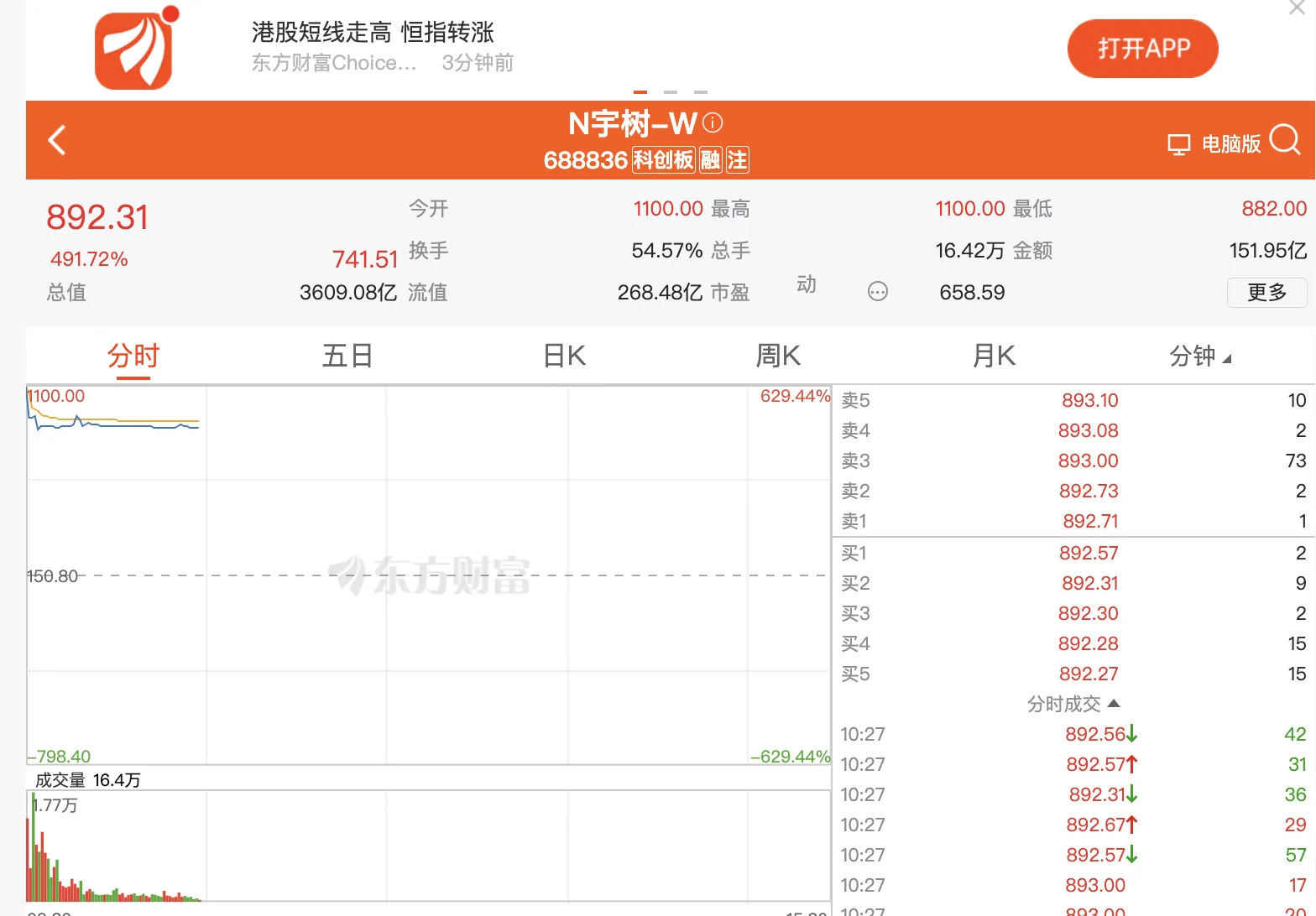
Unitree Robotics made its debut on the Shanghai Stock Exchange STAR Market under the ticker “688836”. According to the source material, the company opened at 1,100 yuan per share, up 949.20 yuan from its 150.80 yuan issue price, a gain of 629.44%. Its market value reached 444.9 billion yuan, and the stock closed the day at 845 yuan per share.
The listing is significant because Unitree is not only another robotics concept company. It grew around robot bodies, motion control and scaled manufacturing. In plain terms, embodied AI means artificial intelligence placed inside a physical machine, such as a robot, so it can sense, move and interact with the real world. Unitree has become widely known for quadruped robots and humanoid models capable of running, jumping and performing eye-catching demonstrations.
The numbers behind the market enthusiasm

Founded in 2016 by Wang Xingxing, a post-1990s engineer, Unitree first gained traction with four-legged robot dogs and later introduced humanoid robots including H1 and G1. The company’s move from product demos to the public market comes with financial data that helps explain investor interest:
- 2025 revenue: 1.699 billion yuan;
- 2025 net profit excluding non-recurring items: 591 million yuan;
- Expected revenue in the first half of 2026: 1.052 billion to 1.128 billion yuan;
- Expected year-on-year revenue growth for the first half of 2026: 35.62% to 45.41%;
- Final online subscription success rate: 0.0181%;
- The 150.80 yuan issue price implied a 2025 diluted static price-to-sales ratio of 35.89 times.
Net profit excluding non-recurring items removes one-off gains and losses, making it a better indicator of core business profitability. The price-to-sales ratio compares a company’s valuation with its revenue; a high ratio often reflects strong growth expectations, but also leaves less room for disappointment.
From impressive demos to industrial productivity

The central question after the IPO is whether Unitree can move beyond being a maker of spectacular robots and become a true productivity company. A robot that can run, dance or perform a backflip demonstrates advanced motion control, but industrial deployment requires much more: lower cost, longer operating time, stable performance in complex environments, reliable mass production and more capable manipulation.
The source also notes pressure on profitability. Because research and development spending and sales expenses are rising quickly, Unitree expects net profit excluding non-recurring items to decline year on year in the first half of 2026. That reflects a broader challenge in robotics: the closer a company gets to large-scale deployment, the more it must invest in better control systems, more dexterous hardware and manufacturing reliability.
Unitree’s IPO therefore marks both a breakthrough and a new test. Public investors will now watch not only robot demonstrations, but also revenue quality, expense discipline, product iteration and repeatable customer demand. In the near term, attention-grabbing performances can still build brand momentum. Over the longer term, the winners in embodied robotics will be companies that can turn machines into dependable tools and convert technical capability into sustainable profit.