
A Large Round for a Voice-First Startup

Wispr, best known for its AI dictation product, has raised $280 million in Series B funding at a $2 billion valuation. Menlo Ventures led the round, and the company said the capital will help it broaden its reach while expanding into areas beyond dictation, including meetings through a newly released note-taking tool.
The financing comes less than 10 months after Wispr’s previous round. With the new investment, the startup has now raised $361 million in total. Existing backers including Notable Capital, NEA, Neo Ventures, 8VC, and MVP Ventures participated again, while Acrew, Forerunner, Goodwater, Peak XV, Together Fund, and PLUS Capital joined as new investors.
The size of the round shows that investors still see room for voice as a major computing interface. Dictation tools turn spoken language into editable text, often using speech recognition and language models to clean up punctuation, formatting, and phrasing. For users, the promise is simple: speaking can be faster than typing, especially for drafts, messages, notes, and mobile work.
Competition Is Rising in Dictation
Wispr is raising at a time when the dictation market is becoming more crowded. The company faces competition from apps such as Willow, Monologue, Aqua, and Superwhisper. The article also notes that some developers are building free or lower-priced products for prosumers, a group that sits between casual consumers and enterprise buyers.
That pressure matters because raw speech-to-text is becoming easier to package. If multiple tools offer similar transcription quality at lower prices, users will compare reliability, workflow integration, device support, and convenience. In that environment, a company like Wispr needs to prove it can be more than a standalone dictation box.
Several numbers define the current moment:
- Series B funding: $280 million;
- Valuation: $2 billion;
- Total funding to date: $361 million;
- Time since prior round: less than 10 months;
- Claimed model improvement: error rate falling from 30% to below 10%.
Canto and the Accuracy Challenge
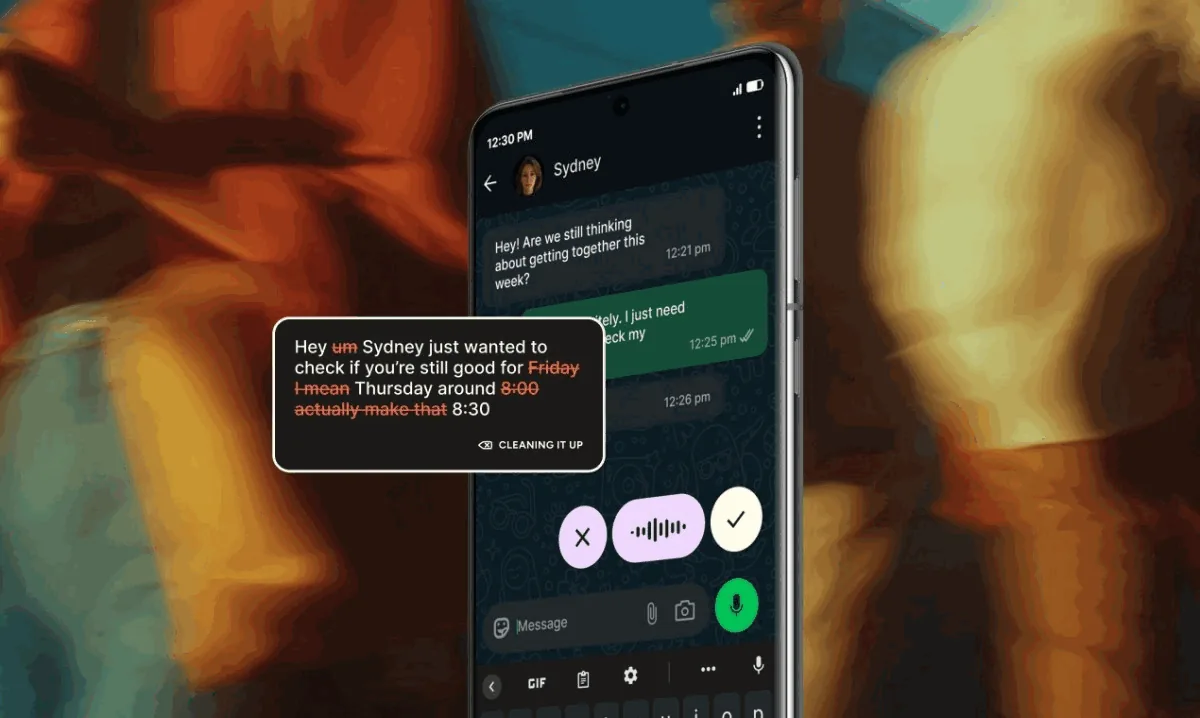
Alongside the funding announcement, Wispr introduced a new speech-understanding model called Canto. The launch follows several weeks in which some users complained about a drop in the quality of Wispr Flow’s dictation output. According to the company, Canto will reduce error rates from 30% to less than 10%.
For a dictation product, accuracy is not just a technical benchmark. If users must spend too much time correcting mistakes, the time saved by speaking instead of typing disappears. That makes speech quality central to retention and willingness to pay, especially when lower-cost alternatives are available.
Wispr has also been expanding distribution. Since last November, it has released its dictation app on Android and scaled go-to-market teams in regions such as India and the U.K. Broader platform availability and regional sales capacity could help the company reach more users who rely on mobile or cross-device workflows.
Meetings, Hardware, and New Interfaces
Wispr is also moving into meetings. Its new note-taker can display summaries and action items, placing the company in competition with products such as Granola, Fireflies, and Read AI. Meeting assistants typically need to do more than transcribe: they must identify key points, capture follow-ups, and fit into the tools teams already use.
The current product still has room to connect more deeply with other software, such as making updates, creating documents, or drafting emails. That direction would move Wispr from input capture toward workflow automation, where a spoken conversation can become structured follow-up work.
The startup is also exploring hardware partnerships, including with the Oasis ring, to let customers dictate on devices without speaking loudly. This addresses a practical barrier to voice computing: many people are uncomfortable talking to devices in shared or public spaces. If hardware makes quieter dictation more natural, voice input may become easier to use throughout the day.
Last month, Wispr announced Wispr Interface Labs under Ariya Rastrow, who worked on Amazon Alexa in its early days. The lab is meant to explore new interfaces for human-computer interaction. In simple terms, a human-computer interface is the way people give commands to machines and receive responses, whether through keyboards, touchscreens, mice, or voice.
What Comes Next
Wispr’s new funding underlines the continued investor interest in voice-driven computing, but it also raises expectations. The company must show that it can maintain high-quality dictation while turning voice into a broader productivity layer.
The next phase will likely depend on two things: whether Canto can restore and improve output quality, and whether Wispr’s meeting, hardware, and interface efforts become everyday workflows rather than side experiments. If it succeeds, Wispr could evolve from a dictation app into a voice-based work interface. If it does not, cheaper dictation tools and specialized meeting AI products will keep pressuring its growth.