
A developer note touches a broader shift
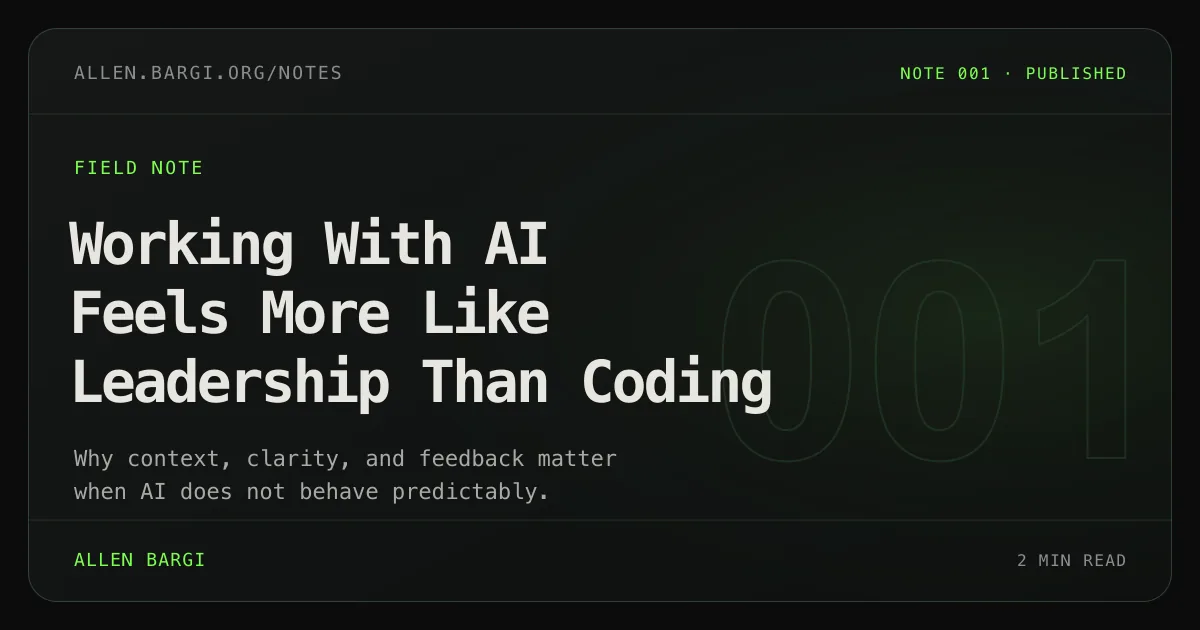
A short essay titled “Working with AI feels more like leadership than coding” sparked an active discussion on Hacker News by arguing that AI-assisted work often feels less like issuing exact instructions to a machine and more like guiding a collaborator through conversation.
The author starts from a familiar software-engineering assumption: code is supposed to be deterministic. If the same input leads to a different result, engineers usually treat that as a bug. Human collaboration has always worked differently. A colleague may do exactly what was requested, produce something better by understanding the underlying intent, or reveal that the original request was not as clear as the requester believed. The essay says working with AI increasingly resembles this second pattern.
Not a person, but not a compiler either
The article is careful not to anthropomorphize AI. It states that AI has no lived experience, accountability, or human judgment. The comparison is about workflow, not personhood. Still, AI systems do not behave like traditional compilers. The same request can produce a different response; a model can make a useful connection, overlook an obvious point, or suggest an unexpected path.
That difference changes how users get value from the tool. If AI is treated purely as a compiler-like system, its variability can be frustrating. If it is treated as a collaborative interface, the interaction becomes more productive. A prompt is the instruction a user gives to a model, but the essay argues that shared working context matters more than a single well-written prompt. Context means background, constraints, examples, preferences, and the criteria for a good result.
What the Hacker News response signals
According to the Hacker News listing, the post drew:
- 300 points
- 190 comments
- A discussion thread on Hacker News
- The original note on the author’s personal site
Those numbers matter because the essay is not presenting a benchmark or a product launch; it is naming a practical experience many technical users are now debating. Software culture has long rewarded precision: decompose the problem, specify the steps, and let the machine execute. Generative AI introduces a probabilistic interface, meaning outputs are shaped by model behavior, context, and generation rather than by one fixed instruction path.
The implication is that users need to express intent more clearly. The essay highlights examples, corrections, and reusable instructions as ways to reduce misunderstanding. Over time, such practices can make the system more aligned with how a user thinks and what the user needs. The investment is not in pretending AI is human; it is in becoming better at stating goals, boundaries, and judgment criteria.
Why this matters for software work
The essay’s importance is less about a new technical claim and more about a shift in everyday practice. AI tools do not remove the need for engineering discipline. Testing, review, and verification still matter. But they add a layer of work that looks like briefing, coaching, and feedback: explain why the task matters, define what a good answer looks like, and adjust based on what comes back.
The likely direction is that strong technical workers will need both coding ability and collaboration skills with AI systems. The valuable habit will not be searching for one perfect prompt, but building a repeatable process: provide context, set limits, inspect the result, correct errors, and refine the next request. In that sense, the author’s point is persuasive: the technology is new, but many of the skills needed to use it well come from leadership practices that already existed.