
Clear-Separated Commercialization Paths Unveiled
In early August 2026, two leading Chinese large language model companies—Zhipu AI and MiniMax—released their first half-year reports since going public, revealing diverging commercialization strategies beyond token consumption.
Key facts and timing:
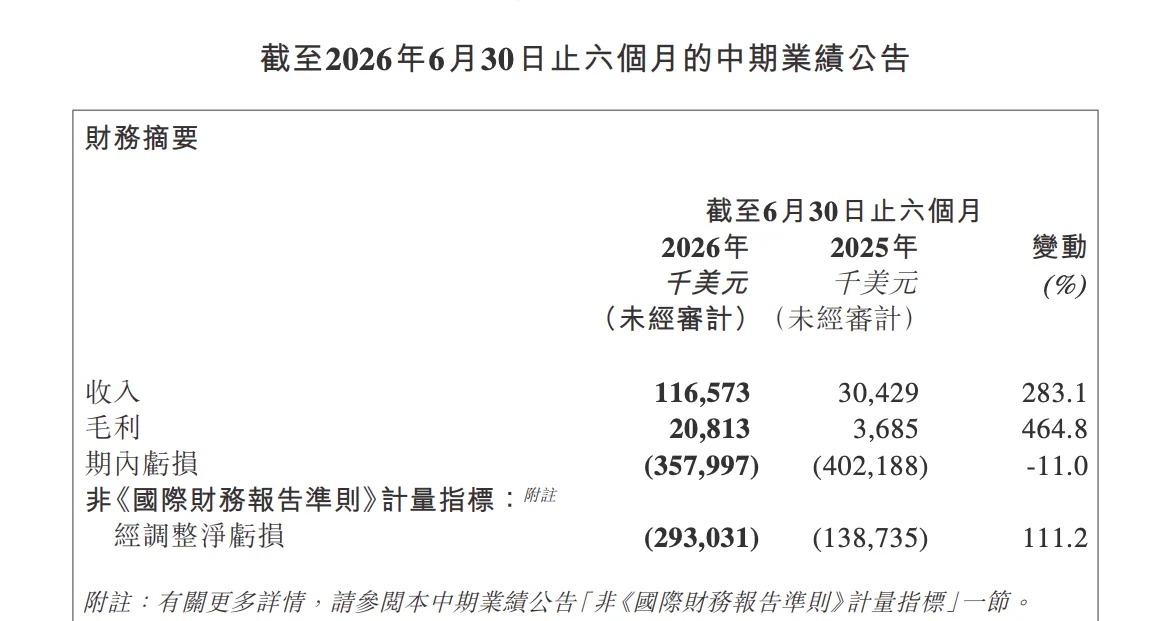
- MiniMax first: reported H1 2026 revenue of $117 million (+283% YoY); Aug ARR exceeded $800 million; enterprise and developer customers surpassed 2 million (+10x YoY); overseas revenue accounted for 60.8% of total
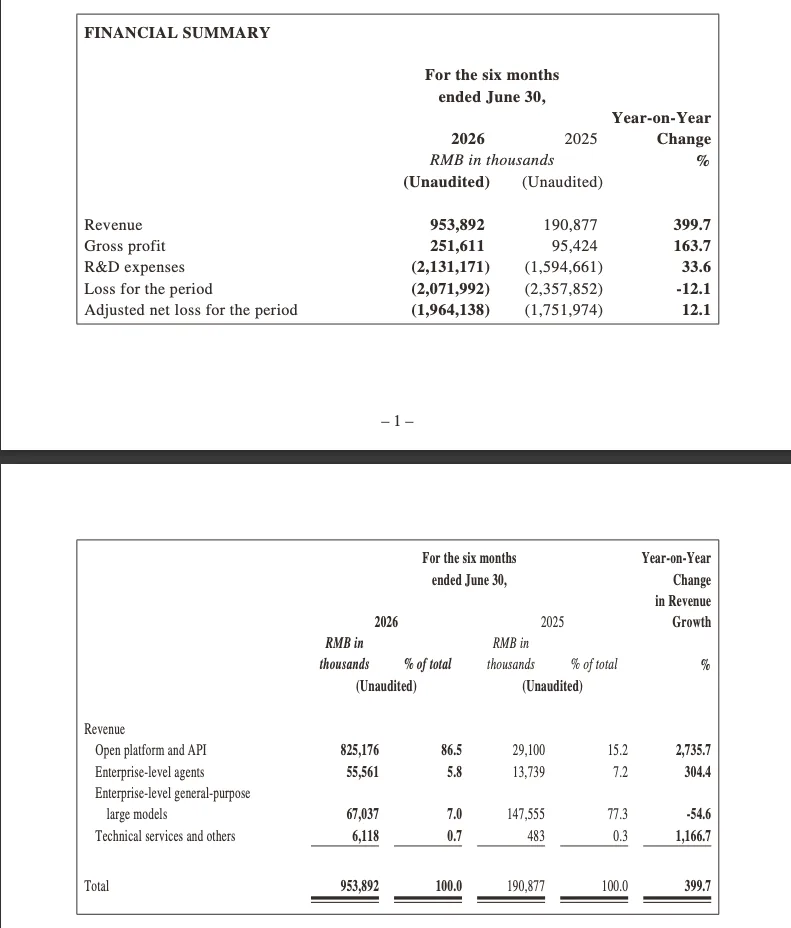
- Zhipu followed: H1 revenue of RMB954 million (~$142 million, +399.7% YoY); August ARR reached $1.6 billion; gross margin of 26.4%; open platform and API revenue contributed 86.5% of total
A key counterintuitive data point: although Zhipu’s ARR figure ($1.6B) appears double MiniMax’s ($800M+), their actual recognized revenues differ by only ~20%. ARR, being an annualized snapshot, can overstate growth intensity compared to contractual revenue recognition between quarters.
Revenue Evolution: From Project Sales to Recurring Subscriptions
Zhipu has undergone a structural transformation. In H1 2026, its open platform and API revenue reached RMB825 million (+2735.7% YoY), contributing 86.5% of total revenue; in contrast, revenue from local deployment of enterprise models stood at RMB67.04 million, down 54.6% YoY. The company is pivoting from “selling model deployments” to “charging by token consumption”—a model that demands high inference efficiency, developer ecosystem support, and consistent API uptime.
Efficiency gains are tangible: API gross margin improved from -0.4% to 24.6% YoY; unit token inference cost fell ~80% since year-end; MaaS platform token volume grew over 40x year-to-date; active paying users surged 603%.
MiniMax’ revenue stream shows stronger globalization and diversification. Enterprise API service revenue reached $73.93 million (+703.1%), while AI-native product revenue stood at $42.64 million (+100.9%). Overseas revenue contributed 60.8% of total. The company emphasizes a dual-track strategy: “MaaS (Model-as-a-Service)” for developers and enterprises, and AI-native products for content creators.
Product Strategies: Raising the Ceiling vs. Lowering the Floor
The two companies pursue opposite but complementary product trajectories:
Zhipu targets intelligence ceiling: June’s GLM-5.2 emphasized long-context coding and agentic capabilities; July’s GLM-5.3 enhanced task execution environment and reinforcement learning, achieving >50% improvement in end-to-end task completion rate; late August’s GLM-5.3-Flash—a sparse model with 32 billion total parameters (18 billion activated)—runs on ~100,000 Chinese-made AI chips at one-tenth the price of GLM-5.2, consuming over 62 trillion tokens in six days. The company introduced an internally-defined “compute multiplier” metric (no methodology disclosed), claiming a 14x YoY improvement in API revenue generated per dollar of compute investment.
MiniMax targets cost floor: June’s MiniMax-M3 delivers stronger coding and million-token context at similar pricing to prior generations; August’s H3, an native multimodal model, was released with open weights. Management stated its inference cost target is to reach one-third of M3’s initial level—not to win a price war, but to expand token volume and commercial coverage through efficiency.
Neither company is yet profitable. Zhipu reported an adjusted net loss of RMB1.964 billion (operating loss: RMB2.147 billion) on RMB2.131 billion in R&D spend; MiniMax posted an adjusted net loss of $293 million (+111.2% YoY expansion) on $297 million in R&D.
Product Line Comparison
| Metric | Zhipu | MiniMax |
|---|---|---|
| H1 2026 Revenue | RMB954 million (~$142M) | $117 million |
| H1 2026 Revenue YoY Growth | 399.7% | 283.1% |
| H1 2026 Gross Margin | 26.4% | 17.9% |
| Core Business Mix | API/open platform: 86.5% | Enterprise + AI-native: ~94% |
| August 2026 ARR | $1.6 billion | $800 million+ |
| Overseas Revenue Share | Not disclosed | 60.8% |
| Latest Model | GLM-5.3, GLM-5.3-Flash (32B sparse) | MiniMax-M3, H3 (multimodal) |
| H3 Open Weights | No | Yes (August 2026) |
Practical Recommendations: Match Use Cases
Adopt now if: Your team has strong engineering capacity and needs high-frequency, cost-efficient API access (e.g., embedding AI into SaaS tools, building code assistants). Zhipu’s API throughput has entered high-performance range, and it offers on-premise deployment options on domestic chips.
Wait longer if: Your use case relies heavily on video/audio generation, or requires out-of-the-box multimodal agents. MiniMax’ H3 weights are open-source, but SLA guarantees for production use remain unannounced. If you require on-premises local deployment (e.g., government, core banking), note that both firms have sharply reduced local model sales—monitor Q3 reports for signs of recovery.
Neither company disclosed concreteCo-work (collaborative workflow) project revenue or acceptance criteria—Buyers expecting “pay-per-result” contracts should wait at least one more quarter for validation.
In closing
Zhipu aims to prove that model capability can command higher-end pricing; MiniMax seeks to demonstrate that lower unit costs can fuel broader ecosystem adoption. Only when the intelligence ceiling and cost floor converge will large language models truly cross the hardest商业化 hurdle.